

Following Pest Movement Can Reveal Whether the Source is Inside the Property or Beyond Its Boundaries
Recurring pest activity can leave homeowners wondering whether an infestation is developing inside their property or whether insects and rodents are continually arriving from somewhere nearby. The distinction matters because treating an on-site nest requires a different response from managing pests that repeatedly enter from an external source.
For anyone seeking an exterminator in North Richland Hills TX, understanding how pest movement is investigated can make the process clearer. Professional pest control service assessments consider the pest species, activity patterns, property conditions, and surrounding environment before determining the most likely source.
A few ants near a kitchen window do not necessarily indicate an indoor colony, just as repeated rodent sightings do not automatically prove that a nest is inside the house. Pests can travel between neighboring yards, green spaces, commercial areas, and residential buildings in search of food, water, shelter, or breeding sites. An experienced exterminator looks for evidence that connects these sightings to a likely source rather than relying on location alone.
Why the Source of an Infestation Changes the Treatment Approach
An on-site nest means pests are nesting, breeding, or maintaining a colony on the property or in an area directly connected to it. Depending on the species, the source might be in a wall void, beneath flooring, in an attic, in a garage, or outdoors near the foundation. In these situations, the treatment plan needs to address the colony or nesting area and the conditions that allow the pests to remain there.
Activity originating from a neighboring property presents a different challenge. Insects may travel through shared fences, vegetation, drainage areas, or small openings between buildings. Rodents may move between yards and structures as food sources and shelter conditions change. Treating only the property where pests are noticed may temporarily reduce visible activity, but it may not prevent new pests from arriving from outside.
The distinction also affects expectations. An on-site nest may require targeted treatment and follow-up based on the pest’s life cycle, while recurring arrivals from outside may require attention to entry points, sanitation, vegetation, and exterior conditions. A reliable residential pest control strategy should account for the actual source instead of assuming every recurring sighting represents the same type of infestation.
What Pest Movement Patterns Can Tell an Exterminator
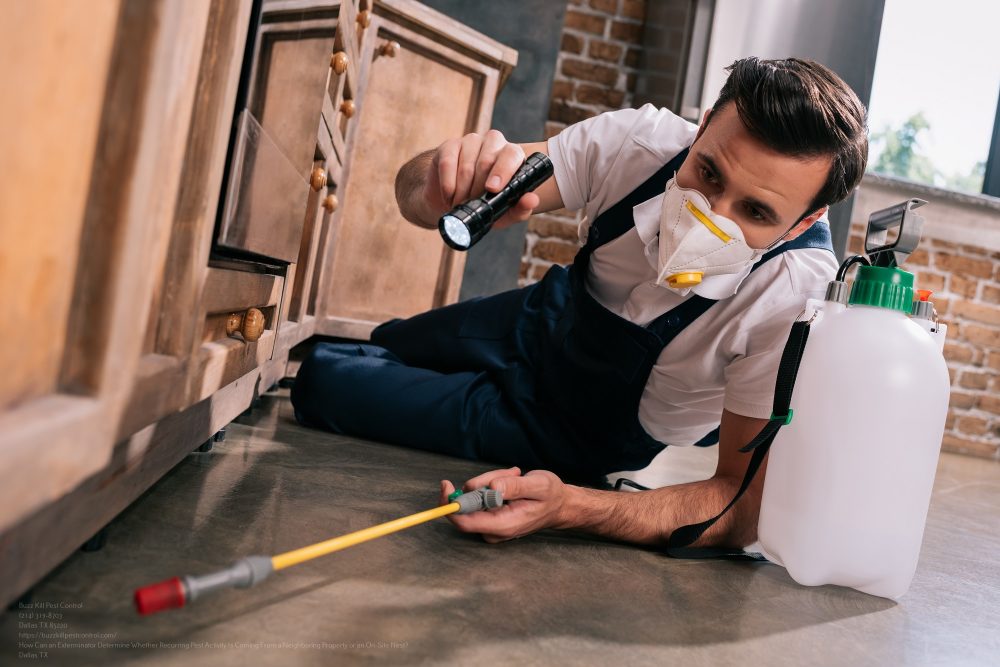
The location and frequency of sightings provide useful clues. Pests repeatedly appearing in one room, near the same wall, or around a particular structural feature may be using a consistent route from a nearby nesting area. For example, ants appearing along a kitchen counter may be following a trail from a wall opening, window frame, or exterior foundation. Their direction of travel, the presence of a trail, and the location of food or moisture can help narrow down the possible source.
Activity across several areas may suggest a different pattern. If insects appear near a garage, patio, or exterior doors, the source may be outdoor movement around the building rather than a single indoor nest. However, multiple sightings do not automatically prove that pests are coming from a neighboring property. An indoor colony can also produce activity in several connected areas, particularly when pests have access to wall voids or other concealed spaces.
An exterminator may also consider when the activity occurs. Some insects are more noticeable during particular times of day, while rodents may leave evidence overnight when household activity is lower. Repeated appearances after rainfall, during warmer months, or when outdoor temperatures fall can provide additional context. The National Pest Management Association’s pest guides also provide information on common pest behaviors, seasonal activity, and conditions that influence pest movement. These observations help distinguish a persistent local population from seasonal movement, although timing alone cannot establish the source.
Want Reliable Exterminator Services?
Contact Buzz Kill Pest Control today and take the next step toward protecting the property from unwanted pests.
How Species-Specific Behavior Helps Narrow Down the Source
Different common pests leave different types of evidence, so an assessment needs to account for the species involved. Ants, for instance, may form visible trails between food sources and nesting areas. Following a trail toward an exterior wall or garden can help identify a possible outdoor colony, while ants repeatedly emerging from a concealed interior opening may justify further investigation. Effective ant control depends on understanding the species and its nesting habits, since not every ant colony responds to the same treatment approach.
Cockroaches and other sneaky insects can be harder to track because they often hide in narrow, dark spaces. Droppings, shed skins, egg cases, and repeated sightings near plumbing or appliances may suggest an established indoor harborage. Yet outdoor cockroaches can also enter through doors, drains, and other openings. The species, evidence, and location all matter when determining whether the property supports an active population or is receiving occasional visitors.
Rodents leave a different set of clues. Droppings, gnaw marks, nesting material, damaged packaging, and greasy rub marks along travel routes can help reveal where they are moving. An exterminator may examine garages, attics, storage spaces, utility openings, and exterior gaps to determine whether rodents are nesting on-site or entering from nearby areas.
Stinging pests require particular care because nest location can affect both treatment and safety. Bees, wasps, and similar insects may establish nests in eaves, wall cavities, sheds, trees, or other sheltered locations. Frequent flight activity around one opening may suggest a nearby nest, but approaching or disturbing the area can provoke defensive behavior.
How Seasonal Conditions and Nearby Properties Affect Pest Activity
Seasonal changes can make an external source appear to be an indoor infestation. During the breeding season, certain insects become more active as they search for nesting locations, food, or suitable conditions for reproduction. Warmer months often bring increased activity from many insects, while cooler months can encourage some pests to seek shelter in garages, wall cavities, attics, and other protected areas. Seasonal pest control takes these changes into account, but the exact timing depends on the species and local conditions.
North Richland Hills and nearby communities, such as Haltom City, feature a mix of residential streets, landscaped properties, retail centers, and green spaces. These different environments can influence where pests find shelter and food. A home bordering dense vegetation may experience different outdoor pest pressure from a property surrounded by paved commercial areas. Nearby landscaping, drainage features, waste storage, and building maintenance can also influence movement between properties.
A neighboring property should not automatically be blamed when pests appear repeatedly. A nearby green space, an outdoor nesting area, or an on-site moisture problem may just as plausibly explain the activity. An exterminator evaluates observable evidence without making assumptions about another property’s condition. Where external activity appears likely, the focus remains on practical steps the affected property owner can take, including reducing attractants and limiting accessible entry routes.
What Happens During a Professional Pest Investigation?
A thorough assessment generally begins with identifying the pest and documenting where activity has occurred. The exterminator may ask when sightings began, whether the number of pests has changed, which rooms or exterior areas are affected, and whether activity follows a seasonal pattern. Photographs, dates, and notes from the property owner can help establish a clearer timeline, especially when pests appear intermittently.
The inspection then considers both indoor and outdoor evidence. Indoors, the focus may include food storage areas, plumbing spaces, wall openings, garage spaces, attics, and other locations where pests can hide. Outside, the assessment may consider foundation gaps, vegetation, drainage, waste containers, exterior structures, and visible nesting activity. The purpose is to connect the evidence to a likely route or source, not simply to count the pests that happen to be visible.
A good investigation also recognizes the limits of what can be established. A pest seen crossing a fence does not prove that it originated in the neighboring yard, and a trail disappearing behind a cabinet does not confirm a nest inside the wall. Some nesting sites are concealed and may require additional monitoring or follow-up. Science-backed pest solutions depend on carefully using available evidence and selecting an appropriate response for the identified species.
Choosing a Response that Addresses the Actual Source
Once the likely source is understood, the response can be tailored to the problem. An on-site colony may require targeted treatment, while external pest pressure may call for better exclusion, removal of attractants, or adjustments to conditions around the structure. Certain situations may also require a combination of methods. For example, liquid barriers may be considered for specific pests and locations when appropriate, but they are not a universal solution for every infestation.
Other services should only enter the discussion when the evidence supports them. Effective termite treatment methods are relevant when termite activity is identified, while bed bug control addresses a separate pest problem that requires its own inspection and treatment strategy. These services should not be added to a plan simply because a property has recurring insect sightings. The same principle applies to commercial industries and residential buildings: treatment decisions should reflect the pest, the structure, and the actual conditions found.
For homeowners, the most useful next step is to share a clear description of the activity rather than assume its origin. Buzz Kill Pest Control can discuss the recurring pest problem and the available exterminator options. Experienced exterminators can use the reported pattern and visible evidence to determine the appropriate response, without promising that every source can be confirmed from a single sighting.
A Clearer Source Leads to a More Useful Pest Control Plan
Recurring pests do not always originate where they are seen. Their travel routes, nesting behavior, seasonal activity, and the conditions surrounding a property all help explain why they keep appearing. Identifying whether the source is on-site or external makes it easier to choose a response that addresses the real problem instead of relying on repeated treatments without a clear purpose. For property owners dealing with persistent activity, Buzz Kill Pest Control can help explore an appropriate pest control plan for North Richland Hills.
For homeowners experiencing recurring pest issues, choosing a reliable exterminator in North Richland Hills TX, can help clarify the problem. A professional assessment can distinguish between an established on-site infestation and recurring pest movement from the surrounding environment, allowing the response to focus on the most likely source. With the right information, property owners can take practical steps to reduce entry opportunities and make future infestations less likely.
Want Reliable Exterminator Services?
Contact Buzz Kill Pest Control today and take the next step toward protecting the property from unwanted pests.